
Inheritance
Goodbye to my mother's house, hello to mine

In April 2002, my mother received a check in the mail for $63,471.63.
It was her share of her father’s estate, split with her four siblings, whom she’d asked to buy her out. She needed the cash.
My father assumed the two of them would use it to make ends meet. He struggled to find industrial design work, earning a paycheck from behind the front desk of a hotel instead. My mother made $36,500 a year as an administrative assistant—her first job after staying home to raise her children since 1984. We lived in a two-bedroom apartment; my older brother slept on a mattress on the living room floor.
But the check was never deposited into my parents’ shared account. When my father asked my mother where it was, she said she lost it and would have to ask her brother to send a new one.
She lied.
My mother used the money to secretly build a new life for herself. She rented another two-bedroom apartment on the other side of our complex and stocked it with furniture and food.
On the first Saturday of summer vacation in June 2003, she dropped the news of her leaving like a guillotine: swift, efficient. She and I moved out the same day.
One year later, my mother bought a home of her own. It was a cozy 1,100-square-foot rambler built to look like a cabin, with cedar siding and a river-rock fireplace. It was built in 1969, but partially destroyed by a fire in the late 90s. When I visited it for the first time, my mother pointed out which rooms were original and which were newly reconstructed, the separation clear.
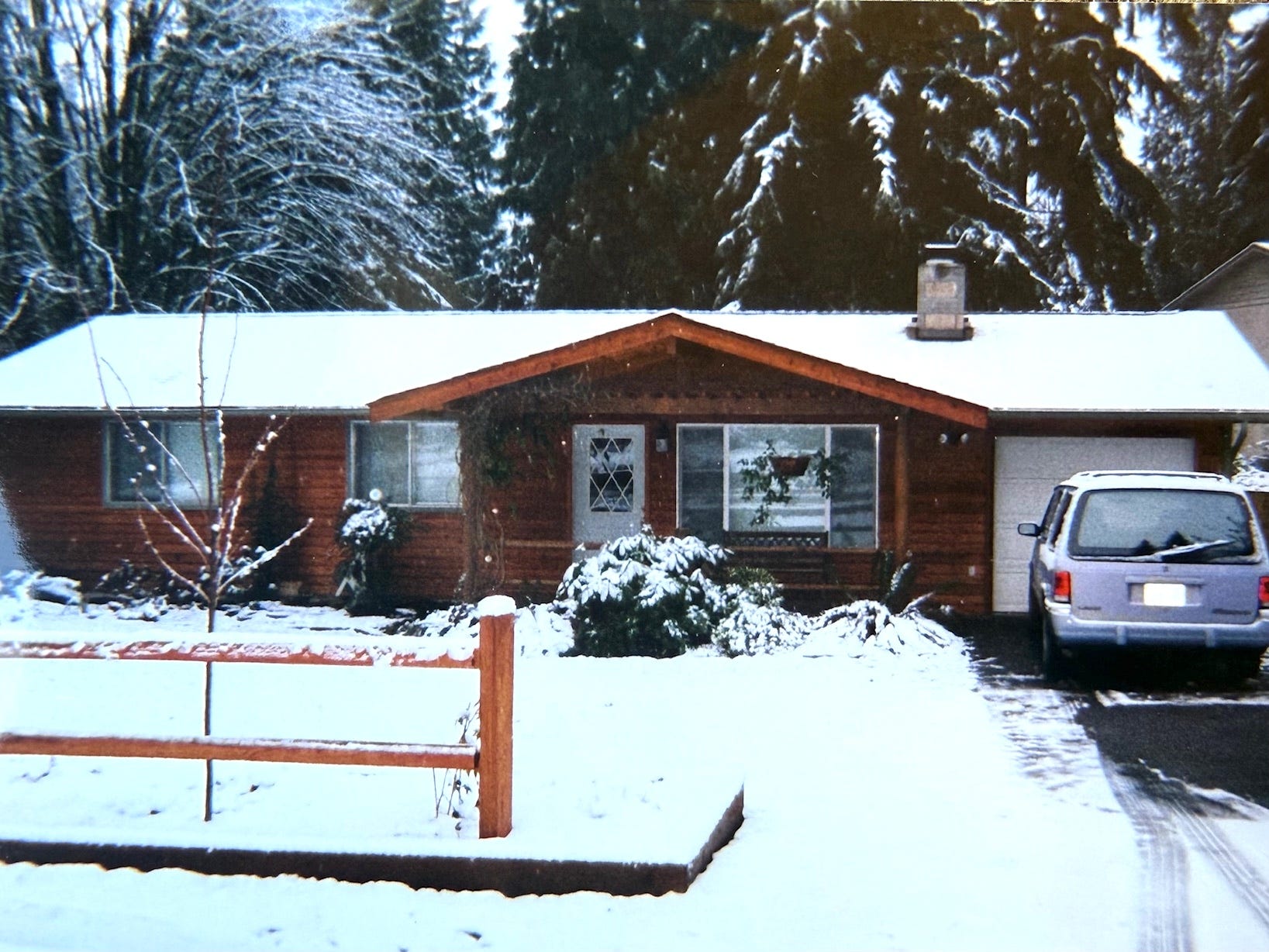
The house was like her: a little scarred, but full of potential.
While still in escrow, my mother went on her very first post-divorce date with Don, the man who would become my stepfather. They met for lunch at The Cheesecake Factory in Bellevue, getting to know each other over fish tacos and a club sandwich. My mother told Don about her new house, saying she needed to buy a refrigerator. They went straight to an appliance store and did just that.
From day one, Don established himself as my mother’s handyman in chief—the person who would help make this house her dream home—and the love of her life.
I have a small quilt featuring a trio of sunflowers that my mother made in 1995. She named it “While Waiting for My Garden”—a nod to the raised beds she was always asking my father to build in the backyard of my childhood home. He never got around to it, and starting in 1996, we bounced from house to house before finally landing in that too-small apartment with no yard at all.


When my mother told Don about her garden ideas for the new house, he jumped into action. “You want raised beds?” he asked. “How big? How many? Draw me a picture.” Then he was off to The Home Depot.
I was freshly 17 and wrapping up my junior year of high school when my mother and I moved into the house. Don drove up to Woodinville from his apartment in Federal Way almost every weekend to bust his ass in the yard: felling gigantic evergreens that threatened to topple onto the roof; constructing a retaining wall with impossibly heavy railroad ties; clearing out grass and leveling the land to set the stage for a spectacular terraced garden.


My mother and Don spent all their free time scooping up seeds and plants at Molbak’s and Flower World, then nestling them into freshly laid soil together. Their efforts grew into an Edenic array of organic produce: Swirling vines of snap peas. Fat, juicy tomatoes dangling from metal cages. Zucchini the size of baseball bats. I wasn’t a fan of getting my fingernails dirty, but even I reveled in the pleasure of picking everything I needed for a dinner salad straight from the garden. I can still feel tender butterhead lettuce leaves between my fingers, warmed by the day’s sun.
Just before I moved out to start classes at the University of Washington, Don moved in. I came home from a post-graduation trip to Hawaii with my best friends to find his toothbrush resting in a cup in our shared bathroom.
Lingering Catholic guilt compelled my mother to have Don sleep in the third bedroom and pay her rent. If he was a boarder, it wasn’t a sin to cohabitate, right? That went out the window sometime after I left.


They still didn’t marry for another 10 years. Everything of value my mother had was wrapped up in that house, and she wanted to maintain sole ownership to have something to pass down to my brother and me. Don had been married three times before and wasn’t keen to go another round.
But something shifted over the years, and they giddily exchanged vows on a Friday morning at the Redmond courthouse in 2015. Tied with the day my daughter was born, it was the happiest I’ve ever seen my mother. She jokingly referred to herself as “Number Four” after that.
Don remodeled the main bathroom of the house himself, swapping the Jacuzzi tub for a more accessible shower they’d be able to use when they were both getting around with walkers and wheelchairs someday.
They saved up for years to professionally remodel the kitchen, dining area, and sunroom. The plans were approved and work was set to begin just as my mother was diagnosed with early-onset Alzheimer’s in 2019.
I remember asking Don: “Are you sure you want to do this? Changing the house is just going to confuse Mom. Shouldn’t you save the money to pay for her care?”
But they went through with it anyway. My mother had painstakingly chosen every last detail, from the cherry cabinets to the quartz countertops to the exact right drawer pulls. It was all part of her dream. The work turned out beautifully, but my poor mother hid in her bedroom, alone and confused, for months while construction workers came and went.
My mother and Don spent their entire relationship making this house their sanctuary—the place where they would live out their retirement and all their days together. That dream died with my mother’s diagnosis.
Now that we’ve settled her remains in a Southern California cemetery with her parents, Don has decided it’s time to move on. Everything reminds him of her. He’s been living with a ghost for years.
For a long time, Don loyally maintained the expansive landscaping the way my mother would have wanted it, but since her death, he’s become free of this duty. The once-lush garden beds, now overgrown with weeds, only remind him of what’s been lost.
Upon their marriage, my mother secured the house in a trust that specifies when it’s sold, the proceeds will be split equally between Don, my brother, and me. It is her legacy; the only thing of significant value she had to pass down to her children. And the timing couldn’t be better for me. The money I’ll get from the sale of her house should be enough for me to become the sole owner of mine.
Inheritance. From my grandfather, to my mother, to me. It’s more than money; it’s freedom. It’s the ability, for my mother then and for me now, to determine our own lives and futures.
I’ve viewed selling my mother’s house from a logistical lens: What needs to happen and when? I’ve learned from my past mistakes and left most of the decision-making and work in this process to Don. His emotions have been running high for several weeks as he’s interviewed real estate agents, sold furniture, and prepared to move out so the house can be cleaned and staged.
My emotions are all hitting me today.
I didn’t think I’d care so much to say goodbye to this house. I always say I didn’t grow up there—but didn’t I?
I never skinned my knees in the driveway or tucked teeth under my pillowcase there, but I did have first kisses on the front porch and boozy parties on the deck (allegedly).
The treadmill in the sunroom is where I made my first strides as a runner, and my mother’s sewing room was where she taught me how to write a budget and pay off my debt after college.
The living room was where my co-worker, Aaron, drank a Sam Adams and participated in a pushup contest to my mother’s delight after our first hike together. Six years later, on that same floor, we laid our newborn daughter on a gauzy cotton swaddle so Nana and Gramps could ooh and ahh over her.
This home is where we labeled my mother’s belongings with her name and packed them up to move her into memory care on one of the worst days of my life. It felt like ripping her from the very fabric of her being—this place she poured her whole heart into. It’s where she staked her independence, put down figurative and literal roots, fell in love, and crafted the triumphant second act she deserved.
That’s why we brought her back nearly every weekend—to reunite her with the physical manifestation of her spirit. Even if she couldn’t quite place how she knew the house, I hope spending time within its walls filled her with a deep sense of belonging and peace. Home is a feeling.


When Don and I discussed selling the house, I invited him to move in with me. So once again, 21 years later, he’s going to fill a spare bedroom and pay rent. He’s going to help a single mother run her household. Sometimes life takes so many left turns, we find ourselves right back where we started.
Both of us are in the middle of major life transitions. It’ll take some time to settle into a new normal. We’ll take our best stab at multigenerational living until Don figures out what’s next for him, and hopefully not stab each other in the meantime.
I’m sure Mom is thrilled we’re going to live together under one roof. If she’s busy haunting us, now she’ll need to make fewer stops.
So many of her dreams got buried with her, but at least this one is going to be fulfilled: She left me a legacy, an incredible gift that’s arriving right when I need it most, and the man she handpicked to take care of her will now help take care of her daughter and granddaughter.
My mother is gone, but every day, her enduring love continues to reach out and cradle me in the most beautiful ways.
If you enjoy reading Rollercoaster Road, please help it grow by liking, sharing, or leaving a comment. Thanks for joining me on the ride.
🥹 Your writing is so emotionally precise and deeply human. This was beautiful.
This is beautiful. And I love that Don will be living with you for a while!