
Roommates
We can never repay each other

If you told 17-year-old me that, 21 years later, I’d invite my mother’s then-boyfriend, Don, to move in with me, I might’ve set myself on fire.
That’s a horrible thing to say, but I had some horrible thoughts at that age.
As I peruse my journal entries from 2004, the phrase “go straight to hell” jumps out as a good indicator of my thoughts about Don.
He came roaring into my life with forceful opinions and history lessons about everything. His factory-setting volume, meticulously fine-tuned by his Sicilian ancestors, is an 11 out of 10.
Don will tell you exactly what’s on his mind, and even mine some footnotes from the deepest, darkest part of his psyche, where we all store the things we really feel but would never actually say. And he doesn’t care whether he’s known you his whole life or you’re just the sucker ahead of him in line at the grocery store. He’s the exact opposite of my amiable, non-confrontational father.
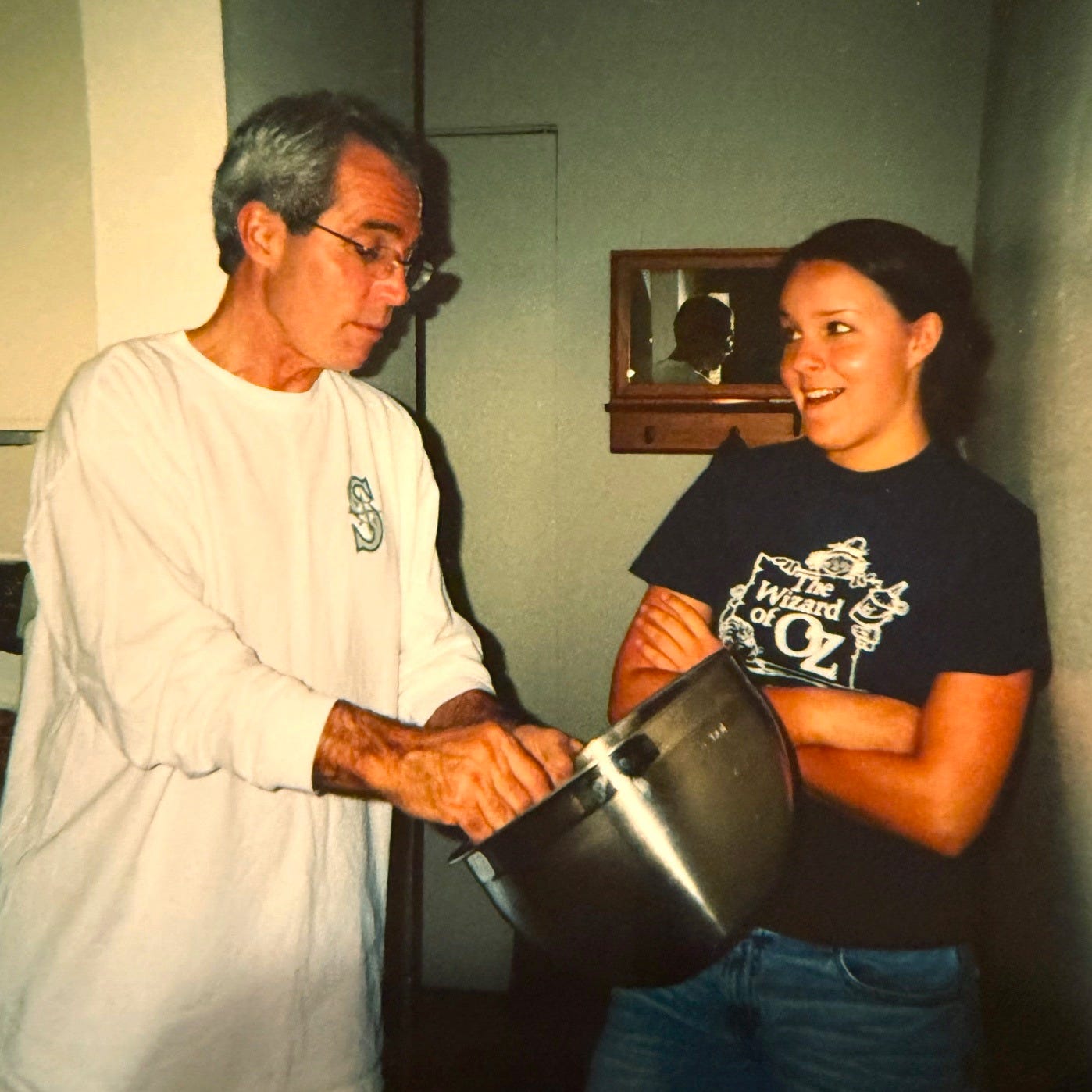
He came off as loud, blunt, aggressive. I bristled. My mother swooned.
Don was exactly what she needed: a Pulp Fiction shot of adrenaline to the heart. He swept her off to jazz clubs and art festivals. He showed her Paradise at Mount Rainier and built her paradise in her backyard. He brought her back to life.
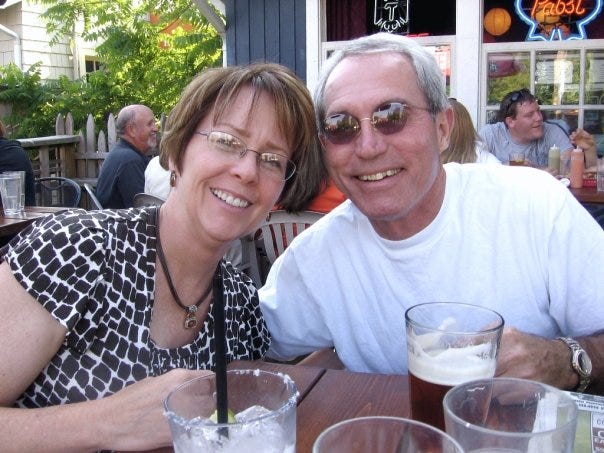
I couldn’t see it at 17. I didn’t yet understand what it felt like to leave a barren marriage and run into the arms of someone completely different.
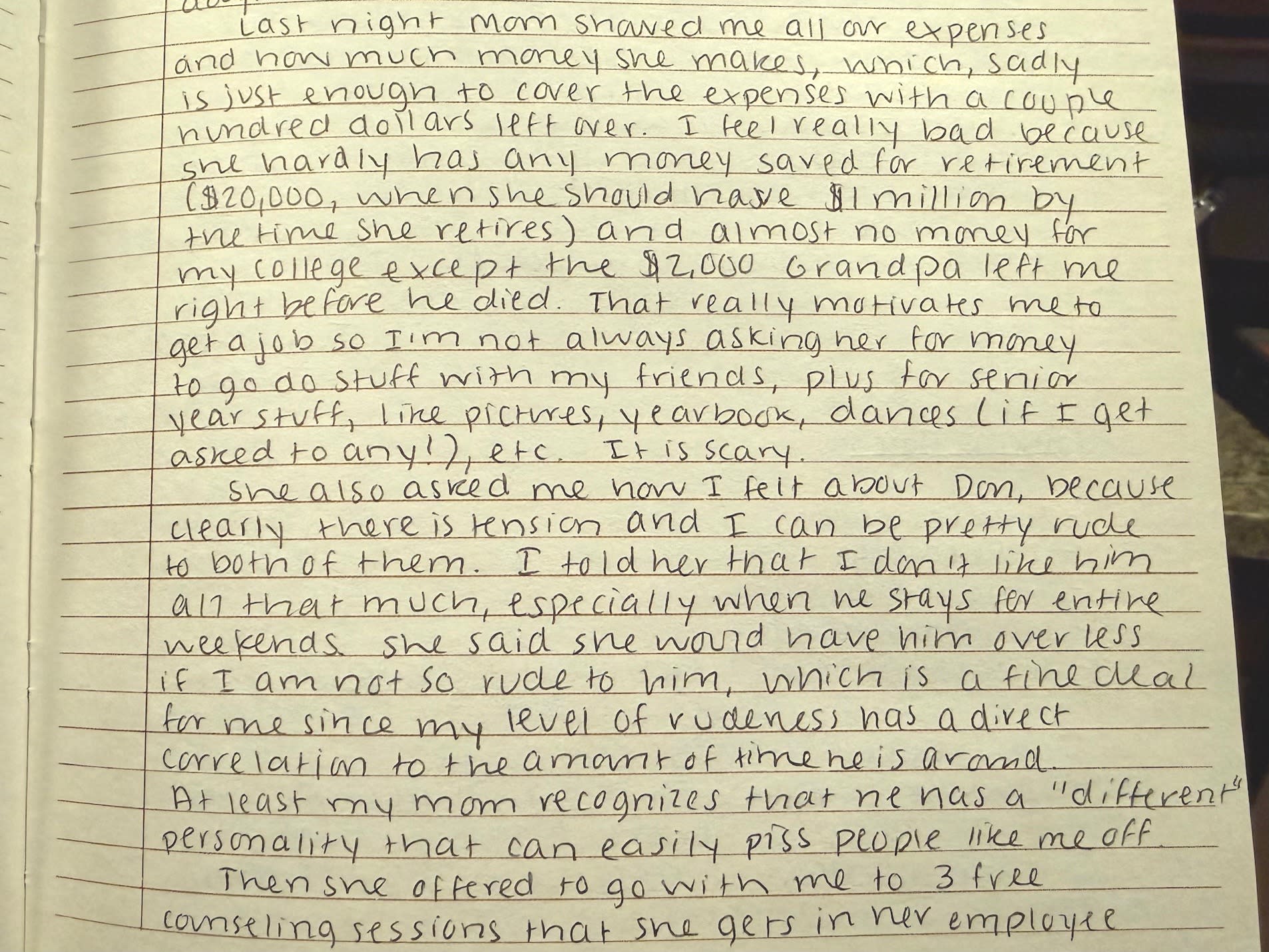
Two months into my mother and Don dating, she proposed we go to family counseling to work through our issues. Don thought my distaste for him was a classic one: “You’re not my father!” But for me, it was truly a mismatch of personalities. He was a bull in the china shop of teenage girlhood. Tact was not in his toolbox, and he couldn’t understand why logic and rationality didn’t work to deal with a person whose wildly fluctuating hormones bypassed those virtues entirely.
We did go to counseling and reach something resembling a truce—more like a stalemate. Don moved into my mother’s house in August 2005, and I moved right out to attend the University of Washington.
I came home during school breaks and summers without any memorable conflicts. He dutifully lugged my belongings from Seattle to Woodinville and back time and time again.
After graduation, I moved home for the foreseeable future and earned my keep watering the garden. That’s when I paid off my debt and began running.
The three of us all ran those first few 5K races, which gave us shared goals to work toward and fun times drinking beer together afterward.
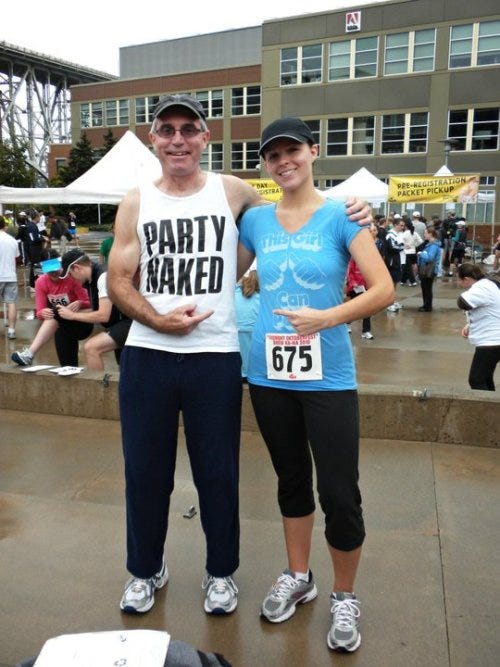
I entered my adventurous era and convinced my brother and Don to go skydiving with me in Snohomish.
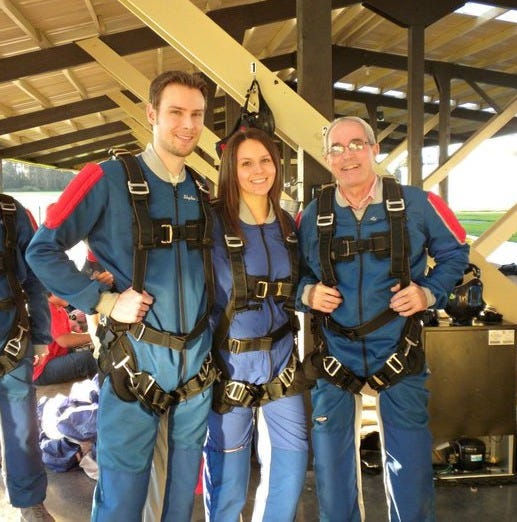
I completed my first triathlon and understood I’d earned Don’s respect when he said this to me after the race: “You should be really, really proud of yourself. I remember when, not too long ago, your favorite things to do were shopping, watching TV, and drinking. Now, you do this stuff. You’ve changed the course of your whole life.”
With a bit of time and wisdom, I grew accustomed to Don’s strong personality and began to appreciate the positive impact he had on my mother’s life. He devoted his entire existence to making her happy. How could I fault anyone who loved my favorite person that much?
But we hit a speed bump in 2012 when he offhandedly mentioned to me that my mother had a suspicious mammogram. What the fuck? She hadn't told me because she didn’t want to worry me. I took my fear out on Don, railing against him for keeping important medical information from me when it was actually my mother who asked him not to say anything.
She was diagnosed with breast cancer in January 2013, and had a mastectomy in February and chemotherapy for the rest of the year. Don did the bulk of the caregiving and went to all her chemo sessions with her, but I remember looking after my mother on Valentine’s Day because he had to go back to work. As I emptied her surgical drains of bloody fluid, I thought, “This is love.”
I had no idea.
My mother married Don in July 2015, and any issues between us were firmly in the past. I gave birth to my daughter, Evie, in April 2016, and they became Nana and Gramps. My mother was not the involved grandmother she’d always said she wanted to be, but I was too distracted wrangling an infant to question why. It wasn’t until her diagnosis in 2019 that I understood the quiet changes in her brain made her hesitant to hold the baby or offer to babysit, for fear she’d say or do the wrong thing—or worse, hurt her granddaughter.
The story turns unbearably sad from there, and if you’ve been following along, you know it ends with my mother’s death in August 2025. But the story behind the story is the incredible partnership Don and I formed while taking care of my mother for the six-plus years of her illness.
It’s one thing to feel an effortless kinship with someone from the start. When everything aligns, a relationship feels transcendent, inevitable. But when you have to overcome adversity—with each other, and together through some of the most brutal challenges on life’s menu—that relationship is unbreakable. Our bond was forged, not found.
Somewhere along the way, we stopped correcting the many neurologists, lawyers, caregivers, and hospice nurses who referred to Don as my father and me as his daughter. I call Don my stepdad only to differentiate him from my biological father. He is one of my fathers. I am his daughter.
So it felt natural to ask him to move in with me. In my mother’s absence, I feel responsible for making sure he’s okay, and vice versa. It’s easier for both of us to do this under the same roof.
We’ve been living together less than a week, so I don’t have much to share about how it’s going yet. I make a bigger pot of coffee each morning. My dog, Wally, is getting more walks from his new favorite person. And because Don is 75, I’m now the default IT person, helping him figure out how to cancel the utilities at my mother’s house and add broadcast TV service, which I was unclear still existed, to my Xfinity account. Given that Evie’s dad calls me “technology Medusa”—a hilariously accurate read—God help us.
Loneliness is as big a health threat to older people as any other risk factor. Don lived alone for five years after we moved my mother into memory care, devoting all his free time to bringing her home on weekends and making sure she had everything she needed. I can never repay him for everything he did for her. He always says the same thing about me.
But now I can introduce him to the charms of my small mountain town: a jazz walk in April, paddle-boarding at the lake this summer, beautiful hikes year-round. He gets enthusiastic snuggles from Wally and a front-row seat to watch his granddaughter grow up.
It’s my turn to bring him back to life.
If you enjoy reading Rollercoaster Road, please help it grow by liking, sharing, or leaving a comment. Thanks for joining me on the ride.
I had no idea I was so likable.
My mom recently moved down the street from me (into a little condo I bought) and my brother moved in with me. I would have absolutely thrown up at this thought a few years ago, but needs and priorities have shifted for all of us and I'm so grateful to have them. I am so, so thrilled you have your family close together and the possibilities for beautiful memories to be made are endless!